The “Meaningful Mess” Method: How to Declutter Without Becoming a Minimalist

Decluttering advice can sometimes make it sound like the goal is an almost empty home. Clear the shelves. Remove the decor. Own fewer things. Keep only the essentials. But what if you actually like books, family photos, collected treasures, comfortable furniture, colorful art, and the little objects that make your home feel lived in? The Meaningful Mess Method takes a different approach. Instead of trying to own as little as possible, you make room for the belongings that genuinely deserve to be there.
What Is the Meaningful Mess Method?
The Meaningful Mess Method starts with a simple idea: a home can contain a lot of things without feeling overwhelmed by clutter. The difference is whether the things around you still have a purpose, meaning, or place.
A stack of books you regularly read isn’t necessarily clutter. Neither is a shelf filled with souvenirs from places you’ve visited, a gallery wall of family photos, a cabinet of dishes you love using, or a basket overflowing with toys your children actually play with.
But the forgotten exercise machine covered in clothes? The cabinet filled with kitchen gadgets nobody uses? The extra chair squeezed into a corner because you didn’t know what else to do with it? Those deserve another look.
Meaningful mess vs. unwanted clutter
| Meaningful Mess | Unwanted Clutter |
|---|---|
| Books you read or enjoy collecting | Books you don’t want but feel guilty removing |
| Decor that reflects your personality | Decor you stopped noticing years ago |
| Furniture your household regularly uses | Furniture without a real purpose or place |
| Sentimental objects connected to specific memories | Objects kept only because deciding feels difficult |
| Supplies for hobbies you actively enjoy | Supplies for hobbies you’ve abandoned |
| Collections you intentionally display | Things accumulating without intention |
Try the “Would I Make Space for This Today?” Test
One reason clutter is difficult to recognize is that we become accustomed to seeing our belongings in the same places. Something can sit in a corner for years without requiring an active decision.
Instead of asking whether you can force yourself to get rid of something, reverse the question:
Would I make space for this in my home today?
Not five years ago. Not someday. Today.
If the answer is yes, the item probably still contributes something to your life. If the answer is no, ask why it continues to occupy the space.
Use the test on more than small clutter
- Sofa: If you were furnishing the room today, would you choose to put this sofa here?
- Desk: Does it still support how you actually work, or is it occupying an entire room because it used to?
- Bookcase: Do you value what it stores and displays, or has it become a landing place for things without homes?
- Exercise equipment: Would you intentionally dedicate this much floor space to the machine today?
- Dining table: Does your household use it, or is it primarily another surface where clutter collects?
- Decor: Would you still choose this piece if you were decorating the room now?
Decide What Deserves to Stay
You don’t need to count possessions or follow a strict limit. Instead, look for the belongings that actively contribute to the home you want to live in.
Keep things that earn their space
An item can earn its place in several different ways. It doesn’t have to be purely practical.
- You use it. Everyday furniture, cookware, tools, electronics, clothing, and household supplies have an obvious purpose.
- You genuinely enjoy it. Art, books, plants, collections, and decor don’t need another justification if they make the home feel like yours.
- It holds meaningful memories. Sentimental belongings can deserve space even when they aren’t practical.
- It supports something you currently do. Hobby equipment and supplies make sense when the hobby is still part of your life.
- It makes the room work better. Useful storage, comfortable seating, tables, shelving, and other furniture can justify their footprint by making the space more functional.
Question things that are staying by default
Some belongings survive every decluttering attempt simply because nobody makes a decision about them.
- Furniture pushed into unused corners
- Duplicate household items
- Old electronics and mystery cords
- Decor you no longer like
- Unused sporting goods
- Abandoned hobby supplies
- Storage furniture holding things you don’t need
- Items saved primarily because they were expensive
Ask yourself
- Do I use it?
- Do I enjoy seeing it?
- Does it hold a specific memory?
- Does it support my life today?
- Does it have a real place?
- Would I choose it again?
- Would I notice if it disappeared?
- Am I keeping it out of guilt?
How to Declutter Without Becoming a Minimalist
If you enjoy a warm, layered, collected home, aggressive decluttering can feel like you’re removing its personality. You don’t have to. Instead of focusing on how many belongings remain, focus on making the belongings you love easier to see, use, and enjoy.
1. Remove the things competing with what you love
Sometimes the easiest way to appreciate a collection isn’t to shrink the collection. It’s to remove the unrelated clutter surrounding it.
A bookshelf filled with favorite novels, framed photographs, and collected objects can feel intentional. Add old paperwork, unopened mail, random electronics, empty packaging, and things waiting to be put away, and the same shelf can suddenly feel chaotic.
2. Give collections boundaries
You can love something and still give it limits. Choose a shelf, cabinet, wall, basket, display case, or other defined area for a collection. The boundary helps the collection feel intentional while giving you a natural signal when it’s time to edit.
3. Let sentimental items be sentimental
You don’t have to justify every possession with usefulness. A chair from a grandparent, photographs from childhood, travel souvenirs, or a box of handwritten letters may deserve space simply because they matter to you.
The more useful question is whether the item itself carries the memory or whether you’re keeping an entire category of belongings because a few pieces are meaningful.
4. Look for invisible clutter
Not all clutter is sitting on a countertop. Some of the biggest opportunities are hidden inside furniture.
- A dresser filled with clothing you no longer wear
- A filing cabinet holding paperwork you no longer need
- A bookcase storing objects you forgot you owned
- A garage cabinet filled with abandoned projects
- A spare-room closet holding furniture and boxes nobody opens
Once the contents are reduced, you may even discover that you no longer need some of the storage furniture itself.
5. Don’t turn decluttering into relocating
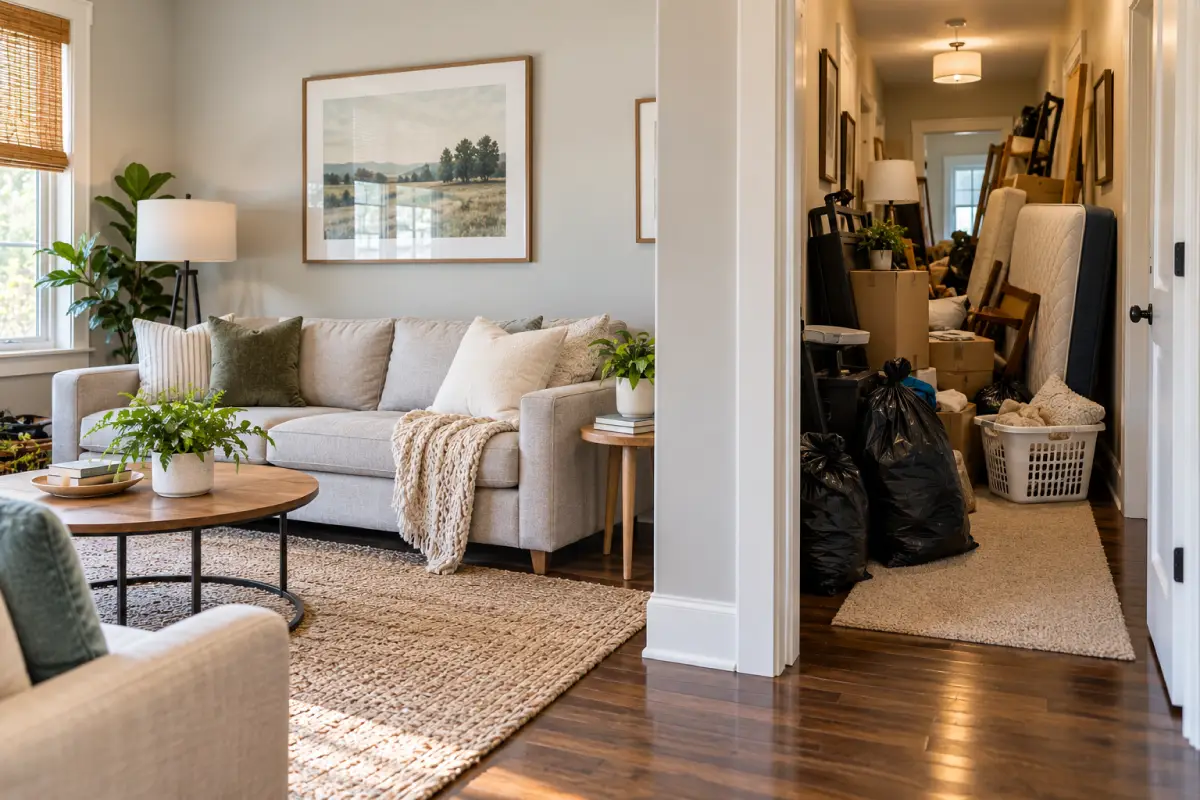
Moving unwanted belongings from the living room to the garage isn’t decluttering. Neither is filling the spare bedroom with donation bags you’ll deal with later.
You can have more without feeling overwhelmed
| Instead of… | Try… |
|---|---|
| Clearing every shelf | Removing things that don’t belong with what you love |
| Getting rid of collections | Giving collections a defined display area |
| Keeping every sentimental item | Choosing the pieces that carry the strongest meaning |
| Hiding clutter in storage | Questioning what you’re actually storing |
| Counting possessions | Evaluating whether each item deserves its space |
| Trying to look minimalist | Creating a home that feels intentional and personal |
| The goal | Keep the personality, lose the unnecessary clutter |
Letting Go Doesn’t Mean the Item Wasn’t Meaningful
One of the hardest parts of decluttering is believing that getting rid of something means it never mattered. That’s especially true for furniture, gifts, inherited belongings, and objects connected to an earlier chapter of life.
But something can have been useful, valuable, or meaningful and still be ready to leave your home.
The dining table may have hosted years of family dinners but no longer fit the way your household lives. The crib may represent an important chapter your family has outgrown. The desk may have supported years of work even though you now use a smaller workspace. The exercise equipment may have been part of a routine that has changed.
You don’t have to erase an item’s history to decide that its time in your home is complete.
Give usable belongings another opportunity
When something is still in usable condition, donation can make letting go feel less like throwing something away and more like passing it forward. Furniture, household goods, sporting equipment, electronics, and other belongings may still have value even when they no longer deserve space in your home.
And when the things you’re ready to release are too large or heavy to move yourself, arranging pickup can help prevent a donation decision from becoming another pile that sits around for months.
FAQ: Decluttering Without Becoming a Minimalist
Your Meaningful Mess Checklist
- ☑️ Keep belongings you genuinely use or enjoy
- ☑️ Ask whether you’d make space for each item today
- ☑️ Give collections intentional boundaries
- ☑️ Keep sentimental items that truly carry meaning
- ☑️ Clear unrelated clutter from favorite displays
- ☑️ Check what’s hiding inside storage furniture
- ☑️ Donate usable belongings you’re ready to release
- ☑️ Keep the personality – lose what no longer belongs